
 Free Shipping Ireland & UK | Now Shipping Worldwide
Introduction – The Missing Piece in Thyroid Science
Millions of people struggle with thyroid disorders hypothyroidism, Hashimoto’s, autoimmune dysfunction, and poor T4-to-T3 conversion yet continue to receive the same shallow, incomplete approach from mainstream medicine:
“Your TSH is fine.”
“Your thyroid is sluggish, here’s levothyroxine.”
“Your symptoms aren’t thyroid-related.”
Meanwhile, these same people are battling:
- chronic fatigue
- brain fog
- unexplained weight changes
- anxiety and depression
- fertility issues
- hair loss
- temperature dysregulation
- persistent inflammation
…and they know something deeper is happening.
The truth is brutally simple:
You cannot understand thyroid function if you ignore methylation, folate metabolism, and homocysteine balance.
And that’s exactly where MTHFR enters the conversation.
The MTHFR gene controls the activity of an enzyme — methylenetetrahydrofolate reductase — that regulates:
- methylation speed
- neurotransmitter synthesis
- detoxification
- immune signalling
- DNA repair
- inflammation balance
…and critically:
Thyroid hormone activation and autoimmune stability.
This article uncovers the connection that standard thyroid care ignores the biochemical crossroads between MTHFR genetics, methylation, T3 production, and autoimmune thyroid disease.
Let’s go deep.
1. The Biochemical Foundation: Methylation Drives Thyroid Function
Methylation is not a “biohacker buzzword.”
It is a biochemical engine powering over 200 essential reactions, including:
- DNA expression
- neurochemical balance
- liver detox pathways
- hormone synthesis
- cell repair and antioxidant recycling
- immune modulation
When methylation slows due to MTHFR variants, the entire thyroid system feels the impact.
Because thyroid hormone biology depends on methylation in four major ways:
1.1 T4 → T3 Conversion Requires Methylation Support
Your thyroid gland produces mostly T4 (inactive).
Your cells rely on T3 (active hormone).
Conversion from T4 → T3 occurs in the:
- liver
- gut
- kidneys
- peripheral tissues
And this conversion depends heavily on:
- sufficient methyl donors
- riboflavin (B2) for the MTHFR enzyme
- B6 for coenzyme formation
- B12 for methyl group transfer
- folate in methylated form (5-MTHF)
- antioxidant capacity
- low homocysteine
- efficient detoxification
If methylation is compromised especially via MTHFR C677T or A1298C — the conversion pathway slows.
Result?
You may have “normal” thyroid labs but low T3 function, a clinical pattern often described as:
- “functional hypothyroidism”
- “poor converter”
- “T3 resistance”
- “non-thyroidal illness syndrome”
And meanwhile, symptoms rage on.
1.2 Liver Methylation Determines Hormone Metabolism
The liver is responsible for:
- converting thyroid hormones
- clearing used thyroid hormones
- recycling iodine
- neutralising hormone-disrupting toxins
Methylation is the liver’s primary chemical tool for:
- detoxification
- sulfate transfer
- glucuronidation
- antioxidant regeneration
If methylation is sluggish, liver stress increases meaning:
Poor thyroid conversion → more symptoms → more inflammation → more methylation demand → even poorer thyroid function.
A biochemical feedback loop.
1.3 Methylation Controls Immune Stability
Autoimmune disorders like Hashimoto’s arise when methylation-related pathways fail to regulate:
- T-cell activation
- immune tolerance
- antibody signalling
- inflammatory cascades
Low methylation → high autoimmunity.
High autoimmunity → thyroid damage.
MTHFR variants directly affect this balance.
2. MTHFR, Homocysteine, and Thyroid Disorders — A Two-Way Dysfunction
When MTHFR enzyme efficiency drops, homocysteine rises.
Homocysteine is more than a lab marker — it is a toxic metabolic stressor.
High homocysteine:
- inflames thyroid tissue
- disrupts hormone manufacturing
- increases oxidative stress
- damages cellular receptors
- impairs mitochondrial function
Research demonstrates:
- Hypothyroid patients consistently show elevated homocysteine
- High homocysteine predicts low thyroid hormone activity
- Autoimmune thyroid disease correlates with low folate + B12
- Oxidative stress worsens TPO antibody expression
This forms a tight biochemical relationship:
MTHFR → methylation → homocysteine → inflammation → thyroid dysfunction → weaker methylation → more dysfunction
A closed loop that must be broken nutritionally.
3. Hashimoto’s, Autoimmunity & MTHFR — The Immunological Bridge
Hashimoto’s is the most common cause of hypothyroidism — and one of the most misunderstood.
Methylation determines:
- how the immune system recognises “self”
- how antibodies form
- how inflammation resolves
- how autoimmunity escalates or stabilises
People with MTHFR C677T or A1298C commonly experience:
- poor methylation activity
- elevated homocysteine
- reduced antioxidant recycling
- impaired detoxification
- altered cytokine signalling
This equals:
Higher susceptibility to autoimmune thyroid disease.
Several studies observe:
- C677T variants appear more frequently in Hashimoto’s cohorts
- Low methyl donors correlate with higher anti-TPO antibodies
- Riboflavin (B2) deficiency worsens mutation impact
- Individuals with MTHFR variants experience more severe oxidative stress response
Does MTHFR cause Hashimoto’s?
Not directly.
Does it predispose someone to autoimmunity via impaired immune-methylation pathways?
Absolutely.
4. Nutrients at the Intersection of MTHFR and Thyroid Function
This is where the dots connect most clearly.
Thyroid hormones rely on the same nutrients required for MTHFR activity.
4.1 Folate (5-MTHF)
Needed for DNA repair in thyroid cells, immune modulation, and homocysteine recycling.
4.2 Vitamin B12 (Methylcobalamin)
Deficiency worsens thyroid fatigue, brain fog, neuropathy, and mood instability.
4.3 Vitamin B6 (P5P)
Required for neurotransmitter creation and methylation reactions.
4.4 Riboflavin (B2)
Critical cofactor for the MTHFR enzyme —
especially important for C677T homozygous individuals.
4.5 Selenium
Central to deiodinase enzymes for T3 activation.
4.6 Magnesium
Required for 300+ enzymatic reactions — including thyroid hormone production and detox pathways.
Deficiency in any of these → poor methylation → impaired thyroid activity.
Deficiency in several → magnified dysfunction.
5. Symptom Overlap — Why Doctors Miss the Connection
Symptoms of MTHFR variants mirror thyroid dysfunction almost perfectly:
| MTHFR Symptoms | Thyroid Symptoms |
|---|---|
| fatigue | fatigue |
| brain fog | brain fog |
| depression/anxiety | depression/anxiety |
| hair loss | hair loss |
| cold extremities | cold intolerance |
| hormonal disruption | hormonal disruption |
| weight issues | weight issues |
| fertility challenges | fertility challenges |
This overlap causes:
- misdiagnosis
- underdiagnosis
- inappropriate treatment
- thyroid medication without addressing biochemistry
This is why many patients say:
“My labs look normal, but I still feel terrible.”
Because labs don’t reflect methylation, homocysteine, or T4→T3 conversion capacity — the real engine of thyroid wellness.
6. Does Supporting Methylation Improve Thyroid Function?
Scientific trends say YES — especially in individuals with:
- Hashimoto’s
- elevated homocysteine
- C677T or A1298C variants
- chronic inflammation
- slow detox pathways
Benefits shown or observed include:
✔ Lower homocysteine
reduces oxidative stress + protects thyroid tissue
✔ Better detoxification
supports hormone conversion + reduces endocrine disruptor load
✔ Improved T3 levels
by supporting liver + gut activation pathways
✔ Reduced autoimmunity
by stabilising immune signalling + lowering inflammatory triggers
✔ Better mood + energy
due to improved neurotransmitter methylation
Supporting methylation does not replace thyroid medication —
but it dramatically improves biochemical conditions that allow thyroid hormones to work properly.
7. Evidence-Based Steps
Here’s what actually helps:
1. Ensure sufficient methylation nutrients
- 5-MTHF
- Methylcobalamin
- B6 (P5P)
- Riboflavin (B2)
- Selenium
2. Test the key markers
Ask clinicians for:
- Homocysteine
- B12
- Folate
- MMA
- TSH, Free T4, Free T3, Reverse T3
- Anti-TPO, Anti-TG
3. Support liver & gut function
Critical for conversion of thyroid hormones.
4. Reduce inflammation triggers
Including:
- chronic stress
- mold exposure
- infections
- ultra-processed diet
- nutrient deficiencies
Conclusion – The Missing Thyroid Link
The relationship between MTHFR and thyroid function is not speculative.
It is biochemical. It is measurable. It is clinically significant.
Methylation sits at the crossroads of:
- hormone activation
- immune balance
- detoxification
- inflammation
- DNA expression
If you ignore methylation, you miss the thyroid.
If you address methylation, you support the entire thyroid axis.
This connection gives patients — and clinicians — a broader, more accurate, and more effective framework for thyroid healing.
#NeuroThrive #MTHFR #ThyroidHealth #Hashimotos #Hypothyroidism #Methylation #GeneticHealth #Bvitamins #Homocysteine #Folate #B12FunctionalMedicine #NaturalHealth #BioScribed #HolisticHealing #HormoneBalance #T3Conversion #MetabolismSupport #ChronicFatigue #BrainFog #EnergySupport #WellnessJourney #Nutrigenomics #Biohacking
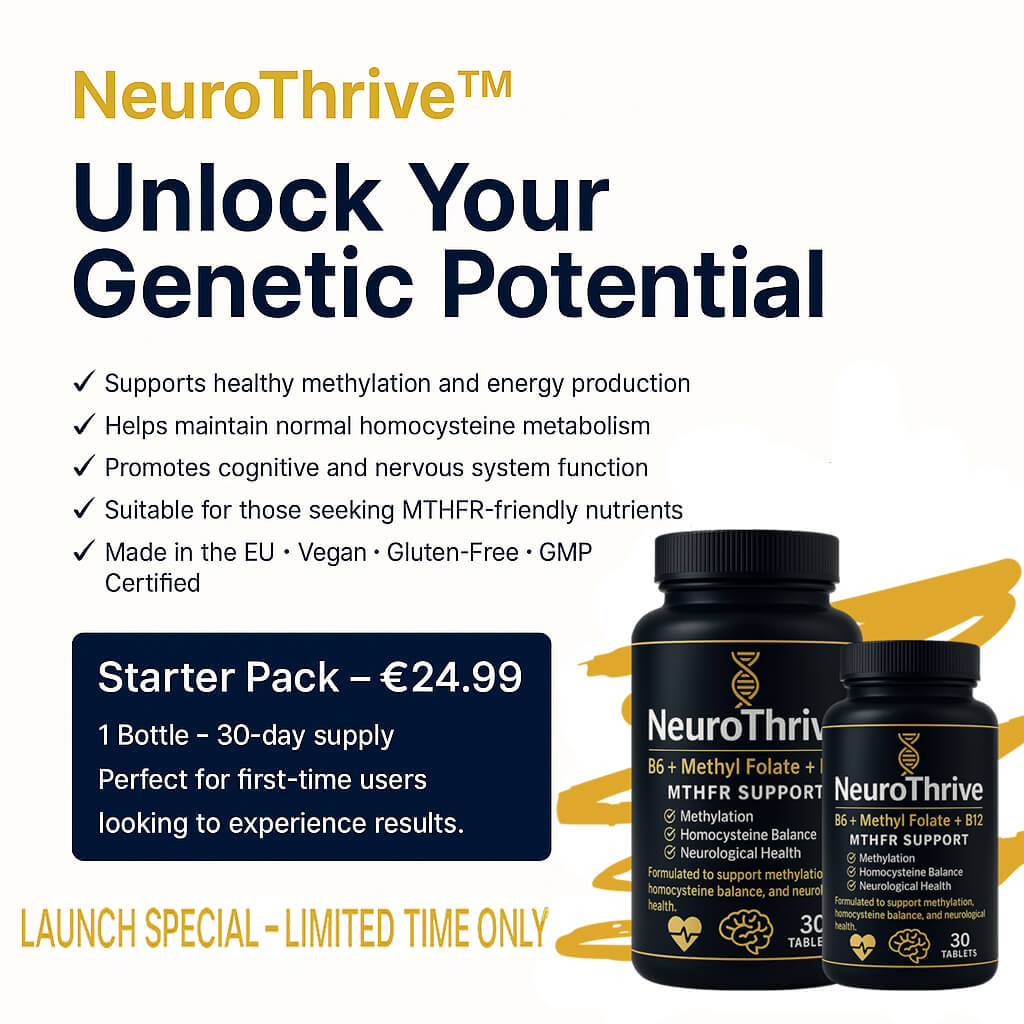
Support Your Thyroid & Methylation – Backed by Real Science
If you’re dealing with hypothyroid symptoms, Hashimoto’s, low T3, or chronic fatigue, it’s not just a hormone issue – it’s a methylation issue. NeuroThrive is formulated with L-5-MTHF, B6, B12 and riboflavin to support healthy methylation, homocysteine balance, and optimal thyroid function at the cellular level.
Shop NeuroThrive – Thyroid & MTHFR Support »