Free Shipping Ireland & UK | Now Shipping Worldwide
MTHFR support supplement,
Introduction: Why We Created NeuroThrive
At NeuroThrive, our mission began with a personal journey: helping families facing hidden genetic challenges like MTHFR mutations and the often-overlooked risk factor known as high homocysteine.
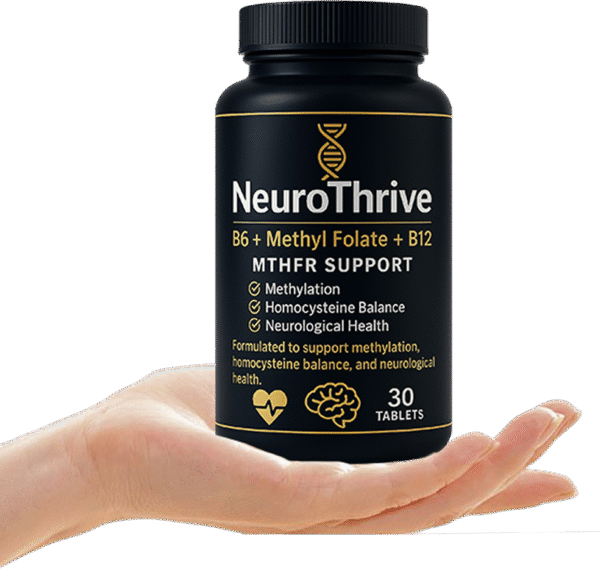
Most people have never even heard of homocysteine, yet it plays a crucial role in conditions ranging from heart disease to seizures. Our formula was carefully designed to address this problem by combining three powerful, bioavailable vitamins:
- Vitamin B6 (as P5P)
- Methyl Folate (400 mcg)
- Vitamin B12 (as Methylcobalamin)
Together, they form a unique support system that helps the body process homocysteine efficiently, supporting brain, heart, and overall wellbeing.
But here’s the key: while this formula is vital for people with MTHFR mutations and high homocysteine, the truth is everyone can benefit from it. Let’s explore why.
What is Homocysteine and Why Does it Matter?
Homocysteine is an amino acid produced when your body metabolizes protein, especially the essential amino acid methionine.
In normal amounts, it’s harmless. But when levels rise too high, a condition known as hyperhomocysteinemia, the risks increase for:
- Heart disease and stroke: Elevated homocysteine damages blood vessels and promotes clotting.
- Dementia and cognitive decline: High levels are linked to Alzheimer’s and memory loss.
- Seizures and neurological disorders: Disrupted methylation affects brain signaling.
- Pregnancy complications: Miscarriage, preeclampsia, and birth defects.
- Mental health issues: Depression, anxiety, and even schizophrenia risk.
A meta-analysis in the American Journal of Clinical Nutrition found that reducing homocysteine through B-vitamin supplementation lowered cardiovascular risk significantly. [Ref 1]
The Link Between MTHFR and Homocysteine
One of the most common reasons for high homocysteine is a mutation in the MTHFR gene (short for methylenetetrahydrofolate reductase).
This gene helps process folate (Vitamin B9). But up to 40% of people worldwide carry a variant that makes it difficult to convert synthetic folic acid into its active form, methyl folate.
Without enough methyl folate, the homocysteine “recycling pathway” slows down, causing homocysteine to build up in the blood.
That’s why people with MTHFR variants whether they know it or not often benefit from supplements that already contain the active forms of folate and B12.
How NeuroThrive’s Formula Works
We designed NeuroThrive’s MTHFR Support Formula with a two-pathway approach:
- Transsulfuration Pathway (with B6/P5P)
- Converts homocysteine into cysteine, which then becomes glutathione (a major antioxidant).
- Remethylation Pathway (with Methyl Folate + Methylcobalamin)
- Recycles homocysteine back into methionine, essential for methylation and DNA repair.
By supporting both pathways, NeuroThrive doesn’t just cover one angle it gives the body two different exits for homocysteine, reducing buildup more effectively.
Ingredient Deep Dive
1. Vitamin B6 (as P5P – 1.5mg)
- What it is: Pyridoxal-5-phosphate (P5P) is the active form of Vitamin B6. Unlike standard B6, it doesn’t need to be converted in the liver.
- Role in homocysteine: P5P drives the transsulfuration pathway, turning homocysteine into cysteine.
- Why it matters: Cysteine is then used to produce glutathione, your body’s master antioxidant.
- Additional benefits:
- Supports serotonin, dopamine, and GABA production (mood & focus)
- Helps energy metabolism and red blood cell production
- Important for hormone regulation
Research highlight: A study in Clinical Chemistry (2004) found that B6 deficiency directly correlated with higher homocysteine levels and impaired methylation capacity. [Ref 2]
2. Methyl Folate (400 mcg)
- What it is: The bioactive form of Vitamin B9, also known as 5-MTHF (5-methyltetrahydrofolate).
- Role in homocysteine: Donates a methyl group in the remethylation process, converting homocysteine back to methionine.
- Why it matters: Unlike folic acid, methyl folate doesn’t require the MTHFR enzyme to become active — making it far more effective for those with MTHFR mutations.
- Additional benefits:
- Essential for DNA repair and cell division
- Crucial in pregnancy for reducing neural tube defects
- Supports neurotransmitter synthesis for mood and cognition
Research highlight: A review in Molecular Psychiatry showed that methyl folate supplementation improved antidepressant response in people with MTHFR mutations. [Ref 3]
3. Vitamin B12 (as Methylcobalamin – 1000mcg)
- What it is: One of the two active coenzyme forms of Vitamin B12 (the other being adenosylcobalamin).
- Role in homocysteine: Works alongside methyl folate in the remethylation pathway, recycling homocysteine to methionine.
- Why it matters: Unlike cyanocobalamin (a synthetic version), methylcobalamin is ready to use and has direct neurological benefits.
- Additional benefits:
- Protects nerves and supports myelin sheath formation
- Improves energy production
- Enhances mood, focus, and mental clarity
Research highlight: A meta-analysis in Neurology (2007) linked B12 deficiency with cognitive decline and elevated homocysteine, showing supplementation improved both markers. [Ref 4]
Who Benefits from Lower Homocysteine?
1. Cardiovascular Health
High homocysteine damages blood vessels and accelerates plaque formation. Lowering levels improves heart and artery health.
2. Brain and Cognitive Function
Homocysteine is toxic to neurons. By keeping it low, you support memory, focus, and long-term brain protection.
3. Mental Health and Mood
Methylation impacts neurotransmitters like serotonin and dopamine. Balanced homocysteine = better mood stability.
4. Fertility and Pregnancy
Methyl folate and B12 support healthy embryo development and reduce risk of miscarriage and birth defects.
5. Energy and Metabolism
Homocysteine balance supports mitochondrial function, which is key for daily energy.
6. Healthy Aging
Elevated homocysteine has been linked to faster aging and higher risk of age-related disease. Lowering it supports longevity.
Why Everyone Can Benefit — Even Without High Homocysteine
It’s easy to think, “If I don’t have high homocysteine, why should I care?”
Here’s why:
- Modern diets are often low in active B vitamins.
- Stress, alcohol, and medications (like antacids or metformin) deplete folate and B12.
- Genetics: Many people don’t know they carry MTHFR variants.
- Prevention: Supporting methylation before problems arise reduces risk long-term.
In short, these nutrients don’t just fix a problem they optimize how your body runs every day.
Backed by Science: Key Studies on Homocysteine Reduction
- B-vitamins and heart health:A meta-analysis of 19 randomized controlled trials found that folic acid, B6, and B12 supplementation lowered homocysteine levels by up to 25%, reducing stroke risk. (Lancet, 2007) [Ref 5]
- B-vitamins and brain health:A study in Proceedings of the National Academy of Sciences (2010) found that B vitamin therapy slowed brain atrophy in people with mild cognitive impairment by reducing homocysteine. [Ref 6]
- Pregnancy and folate:The CDC reports that methylated folate (rather than folic acid) may be more effective in reducing neural tube defects, especially in women with MTHFR polymorphisms. [Ref 7]
Conclusion: Why NeuroThrive is Different
NeuroThrive’s MTHFR Support Formula wasn’t designed to be just another multivitamin. It was built with precision — using the active forms of B6, Folate, and B12 that directly support methylation and lower homocysteine.
Whether you’re:
- Managing MTHFR mutations
- Supporting brain and heart health
- Planning for pregnancy
- Or simply looking for better daily energy and resilience
NeuroThrive provides the foundation your body needs.
Take the step today. Support your methylation, protect your health, and unlock your full potential with NeuroThrive.

From Misdiagnosis to Recovery – Your Child Deserves Answers
Discover how clinical-grade B-vitamins and advanced genetic screening helped Saoirse thrive — and how they might help your family too.
Explore NeuroThrive Solutions »
MTHFR & Thyroid Function: The…
MTHFR & Psychiatric Disorders: What…
The MTHFR–B12 Connection: A Clear…

Methylfolate vs Folic Acid: The…

The Overlooked Link Between Homocysteine…

Cardiac Health Stroke & Homocysteine:…

Epilepsy, Methylation & B-Vitamins: What…

New Studies Reveal the Link…
When a Lifelong Vegan Is…