
If you’re pregnant, trying to conceive, or supporting someone who is, one question matters more than people realize:
Should you be taking Methylfolate or Folic Acid?
For decades, women were told that folic acid was the gold-standard prenatal vitamin. But modern research, genetics, and clinical observations tell a very different story, especially for people with the MTHFR gene variant, a condition affecting up to 50% of women.
Today we break down the real difference between synthetic folic acid and methylfolate (L-5-MTHF) and why choosing the right form can dramatically affect pregnancy outcomes, mood, brain health and fetal development.
🌱 The Core Difference: Synthetic vs Bioactive
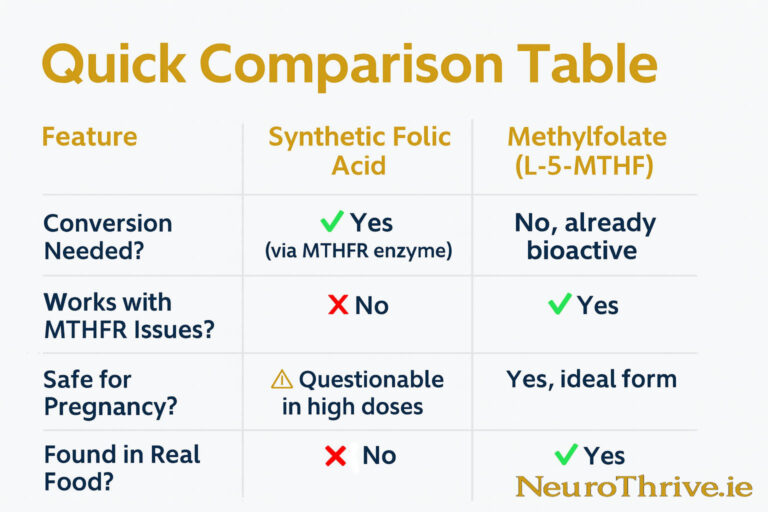
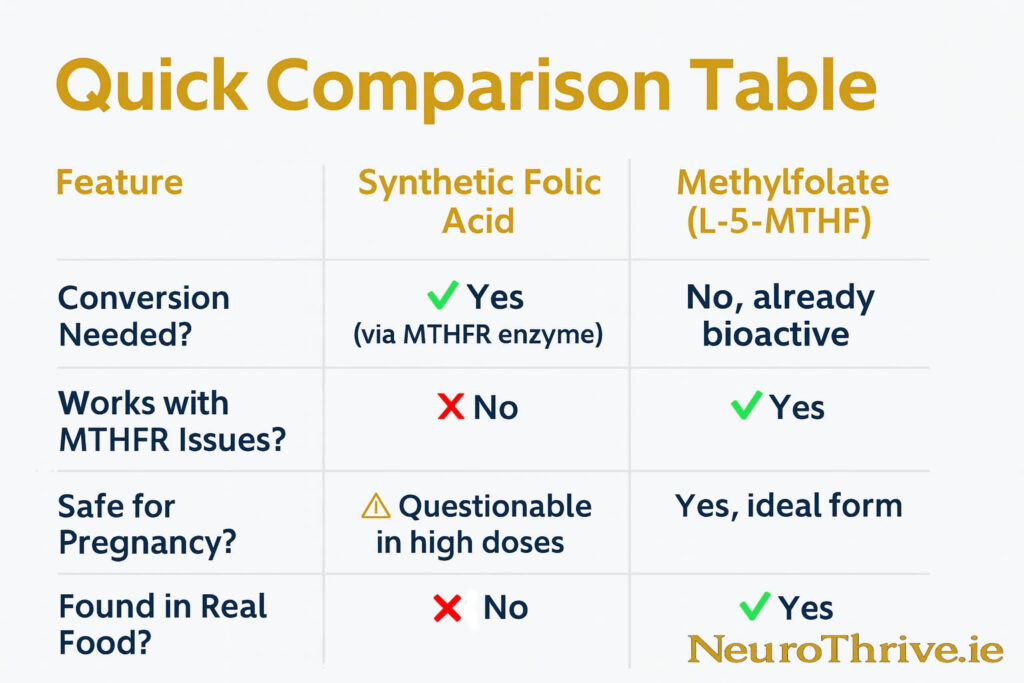
Folic Acid (Synthetic)
Folic acid is a lab-created vitamin found in most supermarket prenatals.
Your body cannot use it as-is. It must be converted using an enzyme called MTHFR.
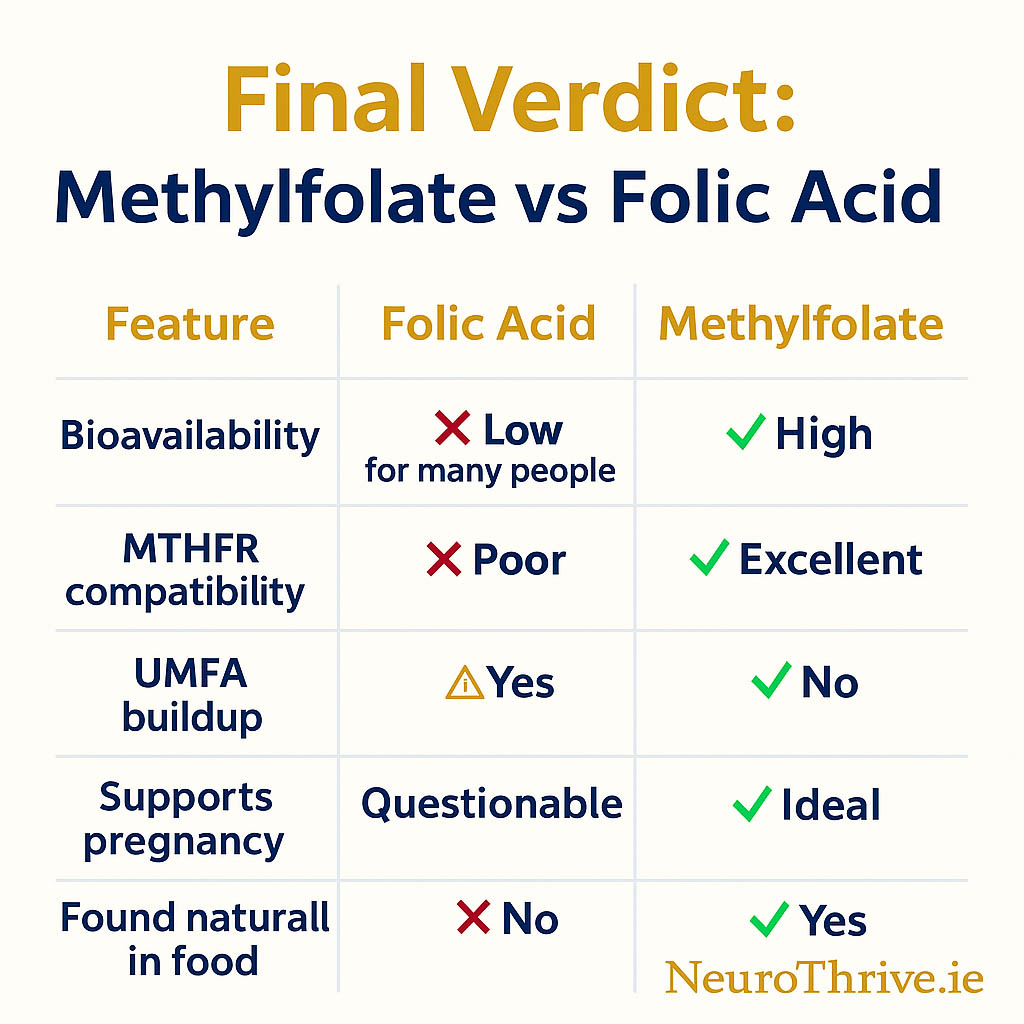
If your MTHFR enzyme is slow, weak, or genetically compromised, folic acid can accumulate in the blood as UMFA (Unmetabolized Folic Acid).
UMFA buildup has been linked to:
❌ Poor methylation
❌ Lower folate status
❌ Immune dysfunction
❌ Fertility challenges
❌ Pregnancy complications
❌ Developmental concerns in children
For women with MTHFR, folic acid can be not only ineffective but potentially harmful.
🍃 Methylfolate (L-5-MTHF): The Active Form Your Body Recognises
Methylfolate is the body-ready, bioactive form of folate found naturally in food.
No conversion. No enzymatic bottleneck.
This is especially important for people with MTHFR because methylfolate:
✅ Supports healthy pregnancy development
✅ Bypasses the gene mutation pathway
✅ Corrects methylation issues
✅ Helps regulate homocysteine
✅ Supports healthy mood & neural development
✅ Reduces risk of folate deficiency
When clinicians refer to “real folate” or “bioavailable folate”, they mean the methylated form.
🤰 Methylfolate vs Folic Acid in Pregnancy
Folate is essential for:
- Neural tube formation
- DNA synthesis
- Placental health
- Baby’s brain & spinal development
- Mood and cognitive function
- Cell repair and division
But here’s the critical part:
*Women with MTHFR can NOT properly convert folic acid into usable folate.
This means they may remain deficient, even while taking folic acid supplements.
Research shows methylfolate:
✅ Raises folate levels faster
✅ Works effectively for MTHFR carriers
✅ Supports fetal neural development
✅ Avoids UMFA buildup
✅ Is the form used in medical studies for brain development
⚠️ Why Many Obstetricians Now Recommend Methylated Folate
Studies now highlight several issues with synthetic folic acid:
🔸 1. Excess UMFA (Unmetabolized Folic Acid)
Occurs when the liver becomes overwhelmed.
Associated with:
– Impaired immune function
– Reduced folate metabolism
– Lower natural killer cell activity
🔸 2. Potential masking of B12 deficiency
Long-term folic acid use may hide early signs of vitamin B12 deficiency during pregnancy.
🔸 3. Limited effectiveness in MTHFR carriers
*Up to 40–60% of women may not fully process synthetic folic acid.
🧬 What About the MTHFR Gene?
MTHFR is a gene responsible for converting folic acid into methylfolate.
Two common variants – C677T and A1298C – reduce this conversion dramatically.
Women with these variants may experience:
- Infertility
- Miscarriage history
- Pre-eclampsia risk
- Postpartum depression
- Anxiety or mood issues
- Elevated homocysteine
- Fatigue and brain fog
Methylfolate supports the methylation cycle directly – no conversion required.
🍼 Is Methylfolate Safe for Pregnancy?
YES ! ! !
Methylfolate is the Natural Form Of Folate Found in Food and in human physiology.
It is widely considered:
- ✅ Safe
- ✅ Effective
- ✅ Bioavailable
- ✅ The ideal prenatal form
Synthetic folic acid, while historically used, is increasingly considered outdated, especially for women seeking an optimised prenatal nutrient program.
🍽️ Real Food vs Supplements
Folate in food = Methylated Folate
Bread/cereal fortification = Synthetic Folic Acid
Women today often struggle to get enough natural food-based folate, making supplementation crucial.
Choosing the correct form matters.
💛 Why NeuroThrive Uses Methylated Folate Only
NeuroThrive MTHFR Support uses:
✅ L-5-MTHF (bioactive)
✅ Methylcobalamin (B12)
✅ P5P (activated B6)
This ensures your body receives the exact forms proven to support pregnancy, brain health, and methylation, without any conversion issues.
Synthetic folic acid, while historically used, is increasingly considered outdated, especially for women seeking an optimised prenatal nutrient program.
⭐ Conclusion
When comparing methylfolate vs folic acid, especially during pregnancy, the evidence is overwhelming:
Methylfolate is safer, more effective, more natural, and critical for women with MTHFR.
Choosing the right prenatal could be one of the most important decisions you ever make for your health and your baby’s.
⭐ Scientific References & Study Summaries
1. MTHFR Genetic Variants & Folate Metabolism
Source: PubMed – https://pubmed.ncbi.nlm.nih.gov/20350330/
Women with MTHFR C677T or A1298C variants show reduced ability to convert synthetic folic acid into its active form. This affects methylation, DNA synthesis, and neural tube development.
Summary: Folic acid is NOT efficiently converted in many individuals, making L-5-MTHF the superior option.
2. L-5-MTHF vs Folic Acid in Pregnancy Outcomes
Source: PubMed – https://pubmed.ncbi.nlm.nih.gov/28315886/
This study compared methylfolate to folic acid in pregnant women. L-5-MTHF showed higher absorption, better red blood cell folate levels, and improved homocysteine regulation.
Summary: Methylfolate supports pregnancy more effectively and avoids conversion problems.
3. UMFA (Unmetabolized Folic Acid) Buildup & Risks
Source: PubMed – https://pubmed.ncbi.nlm.nih.gov/19656062/
Excess synthetic folic acid leads to UMFA accumulation, which can interfere with immune function, natural killer cells, and normal folate metabolism.
Summary: High folic acid intake can create circulating “unused” folic acid, a concern not seen with L-5-MTHF.
4. Active Folate & Neural Tube Protection
Source: PubMed – https://pubmed.ncbi.nlm.nih.gov/27263254/
This research shows active folate (L-5-MTHF) provides direct neural tube support, bypassing metabolic bottlenecks found in folic acid.
Summary: Methylfolate delivers immediate protective folate levels, regardless of genetic variants.
5. Methylation, Homocysteine & Pregnancy Health
Source: PubMed – https://pubmed.ncbi.nlm.nih.gov/30412539/
This study highlights the link between folate forms, methylation, and homocysteine levels—three essential factors in fetal development.
Summary: L-5-MTHF improves methylation efficiency and helps maintain healthy homocysteine levels during pregnancy.
6. Folate Forms & Bioavailability Review
Source: PubMed – https://pubmed.ncbi.nlm.nih.gov/25594457/
A comprehensive review showing that L-5-MTHF has higher bioavailability, better absorption, and more predictable metabolic effects than folic acid.
Summary: Methylfolate is bioactive, reliable, and works without conversion, while folic acid depends on MTHFR efficiency.

Methylfolate #folicacid #MTHFR #MTHFRsupport #prenatalhealth #pregnancynutrition #methylatedfolate #L5MTHF #folicacidrisks #womenshealth #prenatalvitamins #babyhealth #folatedeficiency #neurothrive #homocysteine #methylation

Support Your Folate Levels the Right Way – Backed by Real Science
If you’re comparing methylfolate vs folic acid for pregnancy, MTHFR, or overall wellness, choosing the bioactive form matters. NeuroThrive provides clinically dosed L-5-MTHF designed to support healthy methylation, homocysteine balance, and fetal development.
Shop NeuroThrive – Methylfolate Formula »
MTHFR & Thyroid Function: The…

MTHFR & Psychiatric Disorders: What…

The MTHFR–B12 Connection: A Clear…

Methylfolate vs Folic Acid: The…

The Overlooked Link Between Homocysteine…
